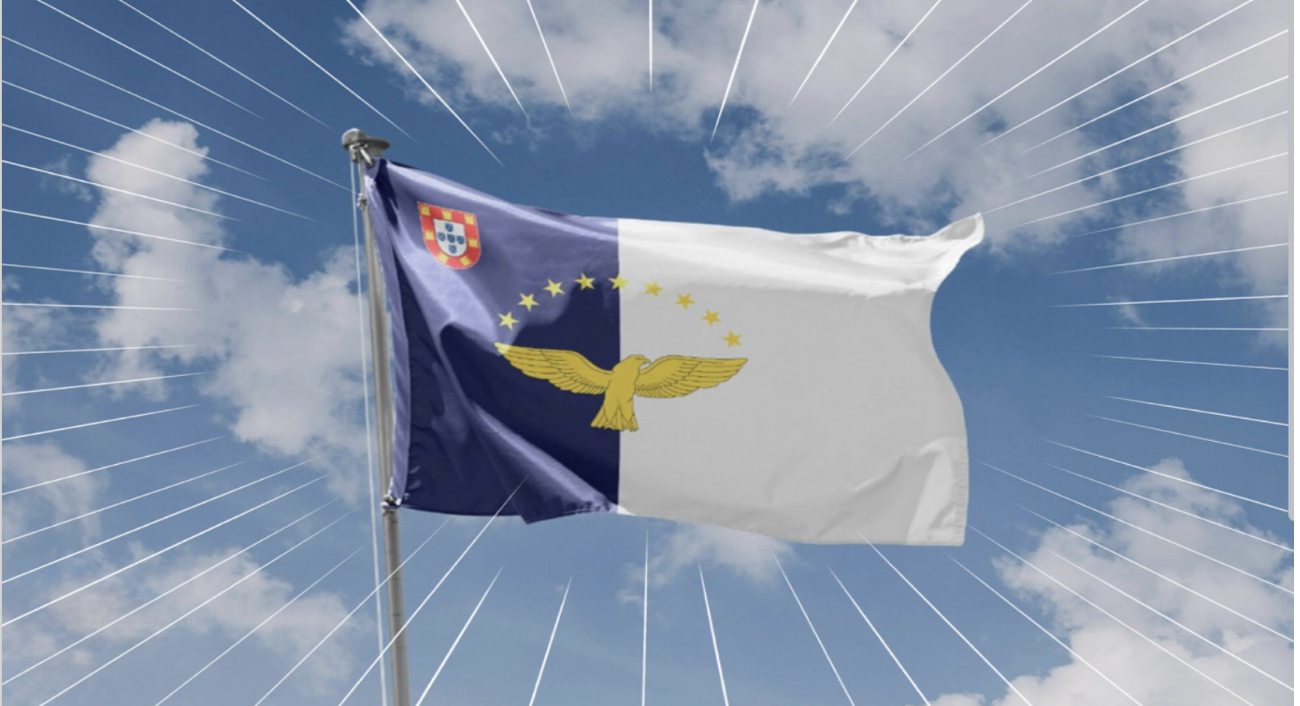
Today is Azores Day, officially known as Day of the Autonomous Region of the Azores, being celebrated across the nine islands of the archipelago. This milestone underscores five decades of self-governance, regional identity, and transatlantic connection.
The President of the Government of the Azores, José Manuel Bolieiro, together with Luís Garcia, President of the Legislative Assembly, presided over the Solemn Commemorative Session marking the occasion, at the official ceremonies celebrated in Ponta Delgada, the Azorean capital city.
The ceremony included tributes and distinctions honoring individuals and institutions recognized for their contributions to public service, culture, education, community life, and the development of the Autonomous Region of the Azores.
A regional holiday, the Azores Day, is the archipelago’s most important event, celebrated on Pentecost Monday (the first Monday after Pentecost Sunday). It coincides with the deeply rooted Festas do Divino Espírito Santo, blending political identity with centuries-old religious and cultural traditions.
 This year’s observance carries exceptional historical significance as it marks the 50th anniversary of the Constitutional Autonomy of the Azores, established under Portugal’s 1976 Constitution following the 1974 Carnation Revolution. The commemorations will culminate on September 8, 2026, marking the formal implementation of autonomy under the Constitution of Portugal.
During the solemn session, President Bolieiro emphasized the importance of autonomy in shaping the modern Azores, stating that “the autonomy of the Azores represents the affirmation of our identity, our democratic maturity, and our ability to build our own future with responsibility and ambition.” He added that the 50th anniversary celebrations are “a tribute to generations of Azoreans who helped strengthen our institutions, our economy, and our place in Portugal, Europe, and the Atlantic.”
Luís Garcia highlighted the symbolic and institutional significance of the occasion, declaring that “the Legislative Assembly remains a fundamental pillar of Azorean democracy and the voice of the people of these islands.” He also stressed that the anniversary serves as “a moment of unity and reflection on the path traveled over the last five decades and on the challenges and opportunities that lie ahead for the Autonomous Region.”
President Bolieiro described the celebrations as “a tribute to the resilience and vision of the Azorean people,” emphasizing that autonomy allowed the region “to shape our own future, strengthen our economy, and affirm our place in Portugal, Europe, and the Atlantic.”
Bolieiro also stressed that the commemorations are intended to belong to the people themselves, declaring earlier this year that “it is the people who must celebrate their own achievement.”
On the meaning of year-long celebrations, the regional leader has also remarked that the 1974 Carnation Revolution “opened up a new historical horizon” for the archipelago by creating the democratic conditions that made autonomy possible, while describing the 1976 Constitution as “a founding moment” that recognized “with clarity and depth” the political and administrative autonomy of the Azores. He further emphasized that “this autonomy is not a gift, but a daily conquest that needs to be constantly renewed.”
Throughout 2026, the Azorean government and regional institutions have organized a year-long commemorative agenda of commemorative initiatives highlighting the five decades of democratic self-government, including conferences, exhibitions, concerts, academic programs, and diaspora events.
Source: azores.gov.pt
Carolina Matos/ Editor/This developing story will be updated
The Azores (population 250,000) is a region of Portugal composed of nine islands. The archipelago, discovered by Portuguese explorers in the 15th century, became an Autonomous Region of Portugal in 1976. The government of the Autonomous Region of the Azores includes the Legislative Assembly, composed of 57 elected deputies, elected by universal suffrage for a four-year term; the Regional Government and Presidency, with parliamentary legitimacy, composed of a President, a Vice-President and seven Regional Secretaries responsible for the Regional Government’s executive operations. The Autonomous Region of the Azores is represented in the Council of Ministers of the Central Government by a representative appointed by the President of Portugal. According to the latest US census, over 1.3 million individuals of Portuguese descent live in the United States, the majority of whom have roots in the Azores. It is estimated that over 20,000 US citizens live in Portugal.

