By Millicent Borges Accardi
Born in Lisboa, Portugal, Hugo dos Santos was raised in New Jersey. An award-winning writer and translator, his books include a collection of short stories about Newark, Then, there (Spuyten Duyvil, 2019), his upcoming book, book A Reduction in Force (Bauhan Publishing, 2026), winner of the May Sarton New Hampshire Poetry Prize, and two translations of José Luís Peixoto: Homecoming (Arquipélago Press, 2024) and A Child in Ruins (Writ Large Press, 2016).
Hugo’s work often explores themes of diaspora, belonging, and memory. In his translations, he says that he is dedicated to bringing contemporary Portuguese literature to English-speaking audiences. His awards include fellowships from MacDowell and the Disquiet International Literary Program, and his individual poems and stories have appeared in Barrelhouse, Bat City Review, Electric Literature, The Common, and elsewhere. Currently, he makes Newark his home.
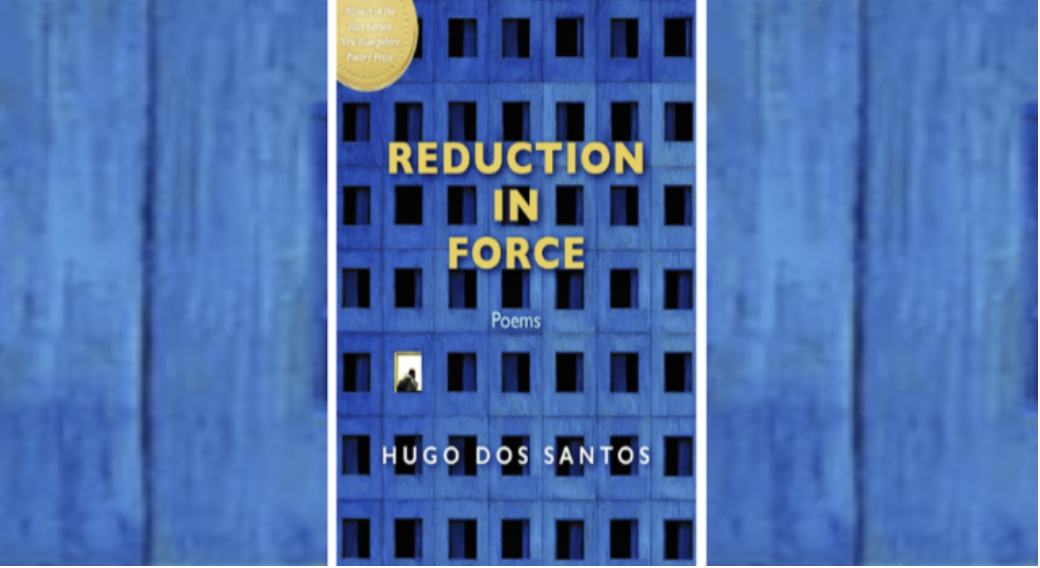
Hugo dos Santos’ most recent book, Reduction in Force (Bauhan Publishing, 2026) is a poetry collection that explores the nature of work, office and cultural norms, family, and immigration. The speaker is a remote office worker with a young family, who has been downsized and begins a seemingly mythical journey to find a new job. At first, his offboarding seems standard and he anticipates the job search to be short and organizes one. However, his life is transformed from being a steady, solid remote worker to a desperate obsession, made more desperate as the weeks and months of being out of work continue: the networking, the loss of job, questioning his self-worth, performance reviews, anxiety, money worries. online searches, preparing resumes, AI, talk of promotions, first day jitters, onboarding, offboarding, computer monitors, desks, endless Zoom interviews, rejection, silence, loss of hope.
The environment Reduction in Force inhabits is decidedly masculine and appears to focus on office work in ways that a poetry collection has never done before in a ground-breaking way, using a newly unemployed remote worker’s journey of looking for a new job as the focal point for the search for the meaning of life itself. A job, a desk, a basement, a laptop, a Zoom screen. An epic journey couched as a job search when it is actually a quest for the holy grail.
In the poem, “Two Kinds,” the speaker states, “Interviews are generally one/of two roads diverging in blue Zoom box.” The backdrop is that place below the surface while readers share the speaker’s dual space and desperation along with him, from entry point to downward spiral, kidnapped by his poetry, taken along on his mythological quest.
Divided into ten sections: The RIF, Prologue, Deception, Unraveling, Recognition, Katabasis, Precipice, Anagnorisis, Climactic Sequence (a redux), and Exodus, Reduction in Force is performed like a Greek tragedy. Pinpointed by and led by each section.
For example. Two pivotal sections. Anagnorisis Section 6 (Mid to Late August) is named for a literary device (from Aristotle’s Poetics), representing a key plot turn when a character moves from ignorance to knowledge by recognizing, or discovering a new or hidden truth about himself or someone else.
As in the poem “Translanguaging,” there is a learning period of trial and error. The speaker is doing imaginary field research to try to discover the secrets of a random selection of what he guesses are employed people, to try and crack the code:
There is a new game
I play where I go
To the supermarket
And imagine. What jobs
Other shoppers. Have
a copywriter. In the cereal aisle,
a marketing manager. In the frozen
section whom I might have met. . .
The poem ending in a Portuguese passage that says the speaker would really like to understand all the words in all the languages in order to name the flavor of all things.
Gostava muito de perceber todas as palavras em todas
As línguas que dão nome ao sabor das coisas
Following the Precipice section, section 8, Katabasi (Mid-September), afterword also from the ancient Greek, the poems in this section represent a descent or downward spiral into the underworld, as evidenced in “Hugo GPT” where the speaker has an argument with AI:
Why can’t I shake this helplessness?
why can’t I find a job?
who am I if I can’t find a job?
And, the poem, “Day 76,” in which the speaker is falling into hopelessness, “… has always been sprinting/ toward the finality of those edges. . .” and fears his fate is sealed, “Change is the longest word I know.”
A second-generation Portuguese immigrant who lives a gentrified existence, the speaker is separated by business projects and family, a person in the darkness of morning or late at night on a hero’s quest for the next big thing, the Holy Grail called the next big remote project.
The search is an earnest urgent one, as the days and weeks pass, fed by a mixture of the old-fashioned need to support a family and the other need of fulfillment, of belonging, of making good in a modern technologically inane world, the words dipping below and above the surface like a long-learned lesson we have to keep repeating.
As the son of a strict Portuguese immigrant father who worked as a waiter, the writer=speaker in Reduction in Force is in a middle place where the old life of dog eat dog has been left behind and, in its place, there is a new 21st century search before him.
The poem called “Day 31” deals with the relationship between an immigrant father, trying to bestow advice on a son, who the father wants a better future for, a father who keeps dignity above all, and respect as a touchstone.
My own father, waiter by trade,
his binding myth was merit,
as in deserving or not, the life
we could make for ourselves.
A chorus of plates and silverware,
tablecloths flapping to spread, parachuting over
tabletops ready. He managed
to sing through that madness,
reminding me to tuck in my elbow.
Finding a job is the new obsessive task. The only goal actually. It is everything.
Each poem in this collection takes us in new directions of the narrative through hope, loss, and error and agony, whether the subject is looking earnestly at a blank screen for wisdom, or going on day trips looking for the answers to everyday and ethereal problems by imagining what careers the other grocery shoppers may have. This collection is a search for a solid place to land.
The poetic voice is pain-seeking and in the forefront of thoughts, the voice is afraid. It should be a simple task to land a new gig to get another job, presumably easy, after the last gig job, finding the next gig job should be easy, but instead, the search this time becomes an all-encompassing, long inner voyage about what is important in life. A search beyond job searches. A search for self. A search for who he is to become next. A search for transformation.
The first poem in the book, “Separation agreement,” calls forth the ghost of Bartleby, the Scrivener, from Herman Melville’s short story by the same name, where a worker at his desk in an office environment awaits the expected call or request so he can respond with the standard phrase of, “I’d prefer not to.”
This poem celebrates the spirit of Melville’s scrivener and notes that it is the burden of the worker bee to be tied to his desk, as a throne, resigning himself, ultimately, to the task at hand: “Had a dream I was Bartleby and when/ the call finally came I was ready/at my desk.”
In “First Day,” the desk is also a focal point, “And I really believed I could/ save the world from my desk” as does “The man who never was” with the line, “the chair where I sit gives into the hungry ground. . .” From the poem, “wanderings,” the speaker asserts, “I am as a body absent from its shell” feeling worthless without a job, as in the poem “Day 48,” which deals with the feelings of the speaker as having no place in the world without a job, “The memories of those former routines/have outlived my spent purpose.” And in the poem titled “Control” the speaker is void of purpose without a desk, without work, “I am a ghost, pretending to be myself/There is no substance here.”
In “Performance reviews,” we are given a bird’s eye view of the immigrant worker who possesses with a strong work ethic, “long/ nights at my desk,” where the speaker ruminates on how he creates value: and a sense of self-worth, “delivering is how I believed my way into belonging.”
The message between meaning and earning money is cemented into place in “Work,” where “work is meaning, and I know that is wrong.” The speaker realizes he wants more out of life than being a breadwinner and takes this offboarding as an opportunity to find new meaning in his life. In “network,” the speaker declares a goal, a small and impactful idea for the future, “I just want to do good work/ with smart people, be part of a team.” It is a plea for his life to matter. A mantra almost: “I just want to do good work/ with smart people, be part of a team.”
A phrase, “repetition is a comfort,” in the poem “Big Week,” stands at alert, as a mantra in a land where “repetition is a comfort” because “repetition is a comfort,” as if the speaker is giving himself a pep talk. That, if he is only able to repeat the same tasks again and again, as a routine, he will be relevant and promptly rewarded. He will be safe. In repetition is safety. Security. In a job there is the ultimate security.
Because the speaker’s job is not specifically revealed in the poetry, he becomes an everyman, an any man, a generic sample of a person who is looking for his next office gig. Not the company. Not the job title, or the tasks, except that the work is remote and involved in presentations and meetings, possibly computer work presumably the written word. A faceless seeker.
The angst of a desk job, trying to get work, remote work and raise a family, all without mentioning what kind of work the speaker is doing. It’s a general office job without specifics. It could be any family man from an immigrant family, a hard worker who was raised with the dictum of get a good job and stay with it for life, the having to get new jobs and bouncing around are unsettling to our speaker.
I don’t think I have ever read a poetry collection dedicated to the life of a remote office worker. It makes me wonder what kind of work is being done. Statistics, engineering, computer programing, perhaps someone more dangerous collecting statistics or accounting for a mafia boss. The type of work is never named. How soul crushing work is, especially looking for work, sending thousands of resumes out. Each new gig a new dream or an opportunity like a marriage that you hope will either last or that you will be the one to make the change, the offboarding, not the employer. How at affect you are to a corporation, any corporation, particularly remote when it is easier to stop employing you. At will. With not even the daily vibes to secure your place on the corporate ladder. The corporate ladder has no rungs. When you are on a ladder in the basement, each rung is only as high as the desk where you are sitting.
The worker is a contractor or employee, but he is not a temporary worker, not a day jobber or someone on “Fiverr or Dice,” the equivalent of a white-collar job. The speaker is looking for a new home. Something stable, claiming in “The oneiric world,” a dream of chasing a train or a plane, never knowing what to expect, is like “searching for the right vessel, is like someone seeking salvation.”
In total, the speaker in Reduction in Force, originally thought it was going to be easier to land a job, easier than it actually was, and the poetry collection outlines his coming to terms with himself and his search. In the beginning, the speaker was organized and prepared, a man completely unready for the endless uncertainty, the barrage of pressure that financial trouble and spiritual limbo would take on his sanity. Ill-prepared for the journey to last as long as it is lasting.
Therapy seems to help him cope. In the poem called “Break,” the repetition of therapy seems to be a description of how healing should work to calm his anxiety. It is the routine not the therapy that helps the most. “I’m doing the therapist thing/I don’t know if it is doing anything/but it feels like doing something./ So I go.”
Excerpt from Reduction in Force “Work“
Work is meaning, and I know this is wrong. Work
is meaning, and I’m compensated for it. Work is
meaning to get to that spreadsheet when I’m back
at my desk on Monday, it’s meaning to finish
an email or IM, it’s meaning to finally get that
project off the ground. It’s the way I think about
what I contribute to the world. It’s the label
that appears next to my name, how I might
be introduced at a party or to (a) new company
or when someone new joins the team
at work. Work is meaning in the face of rising
seas and heat and coups and disappearings.
It’s the new assimilation, reason to forget
my mother(’s)tongue. It’s the implicit why
for the latest business book I’m reading
or that new podcast on auto-download, it’s how
my children see me contributing to the world
as they learn about its apathy. It’s what
they think about when someone asks them
what they want to be when they grow up.
Related Post
Hugo Santos: A sense of self rooted in the immigrant experience – Interview
———————
Book Details
Title: Reduction in Force: Poems by Hugo dos Santos
Author: Hugo Dos Santos
Publication date: April 14, 2026
Language: English
Publisher: PuBauhan Publishing
Paperback: 120pp
Available @ Amazon.com

————————–
Millicent Borges Accardi, a Portuguese-American writer, is the author of four poetry books, including Through Grainy Landscape, (inspired by Portuguese writings. She has recent work in Paris Review, American Poetry Review and Glass. Her writing awards include fellowships from the National Endowment for the Arts, Fulbright, PEN America, CantoMundo, California Arts Council, the Foundation for Contemporary Arts, and Fundação Luso-Americana (Portugal). She serves as a mentor in the AWP Writer 2 Writer and Adroit writing programs and curates the popular Kale Soup for the Soul reading series.

