Since late January, Portugal has confronted the cumulative impact of three successive Atlantic winter storms, which have caused fatalities, infrastructure destruction, flooding, and emergency response operations across the mainland, including Madeira and the Azores regions.
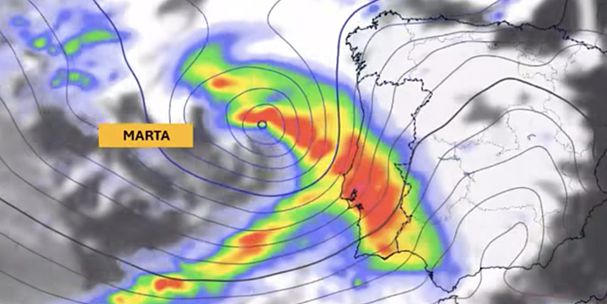
Over the weekend, a third storm front, named Marta, developed across the municipalities of Leiria, Coimbra, Santarém, and Lisbon districts, where many residents are being displaced and local economies are being disrupted, with hundreds of thousands of residents experiencing power outages.
The crisis began in late January, with Storm Kristin, which struck central Portugal with destructive winds exceeding 200 kilometers per hour, characterized as catastrophic. At least six fatalities were directly attributed to the storm, with indirect deaths during cleanup and recovery bringing the total to approximately eleven.
Following Storm Kristin, Storm Leonardo developed, bringing sustained rainfall to an already saturated terrain. Flooding and landslides affected multiple regions throughout central Portugal’s coastline and the Algarve, resulting in at least two additional deaths and forcing thousands of evacuations.
River basins, particularly along the Tagus and Douro, experienced severe overflow risk, leading authorities to extend the state of calamity across dozens of municipalities.
On Saturday, a new storm named Marta was forecast to bring heavy rainfall, strong winds, and rough coastal conditions through the weekend. The event has prompted heightened national preparedness measures and the mobilization of thousands of emergency responders.
Civil Protection officials described the threat as the most serious in nearly three decades. Officials warn that saturated soils and previously damaged infrastructure increase the likelihood of further flooding and landslides.
Prime Minister Luís Montenegro, who described the situation as a devastating national crisis, acknowledged that recovery would be long and demanding. He declared a nationwide state of emergency to last until February 15.
Reconstruction efforts are underway, including government initiatives such as emergency loans for homeowners and businesses, wage-support programs designed to protect employment, accelerated rebuilding permits, and coordination with humanitarian agencies distributing assistance to affected residents.
Economic losses have been estimated to exceed $4.7 billion, prompting the Portuguese government to approve a reconstruction package valued at approximately $3.0 billion.
Authorities are also exploring European Union solidarity mechanisms to help offset the financial burden. Recovery is expected to extend over several months, particularly for industrial facilities and agricultural producers facing prolonged disruption.
Most severe destruction and fatalities have been concentrated on the mainland, with no comparable large-scale impact confirmed in the Autonomous Regions of the Azores or Madeira.
For Portuguese communities abroad, including in the United States, the storms have heightened concern for relatives, hometowns, and property in affected areas.
The storm sequence, impacting Portugal, illustrates a phenomenon sometimes described as “storm training” in which multiple systems follow similar paths, similar to railroad cars passing over the same spot on a track. This meteorological phenomenon often results in excessive, localized rainfall and significant flash flooding, as multiple storms dump rain on already saturated ground, which contributes to increasingly severe weather events.
PAJ/Staff/This developing story will be updated
Related Posts

